

 News about the Technical University of Crete RSS feed
The Hellenic Artificial Intelligence Society, the Technical University of Crete, and the Region of Crete are co-organizing the 14th Conference on Artificial Intelligence (AI), which will take place at the Chania Cultural Centre from September 9 to 11, 2026.
The SETN conferences are held biennially by the Hellenic Artificial Intelligence Society (HAISS), the scientific association of Greek AI researchers and a member of the European Association for Artificial Intelligence (EurAI). SETN 2026 is co-organized by the School of Electrical and Computer Engineering (ECE) of the Technical University of Crete and the Region of Crete. The conference is dedicated to the memory of Greek scientists Pavlos Peppas and Themis Panagiotopoulos, who passed away prematurely.
The SETN 2026 program features talks by distinguished Greek and international researchers, as well as presentations of research papers in the following areas: Machine Learning, Natural Language Processing, Knowledge Representation and Reasoning, AI Applications, Knowledge Graph Construction, and Robotics.
On the first day, Wednesday, September 9, 2026, at 5:00 p.m., the program will feature robotics demonstrations, with free admission for the public, by the following laboratories and research groups:
Computer Vision and Robotics Laboratory, Institute of Computer Science, Foundation for Research and Technology – Hellas (FORTH), Lead: Professor Panos Trahanias
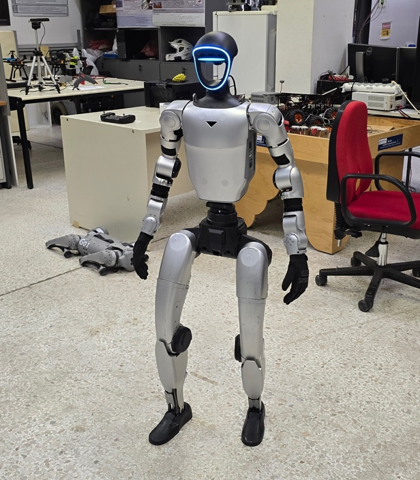
“A standard RGB camera will continuously track a person and record, in real time, the movements of their upper body. These movements are translated into corresponding commands for the Unitree G1 humanoid robot, allowing it to accurately imitate the person’s gestures and posture. At the same time, a trained Reinforcement Learning (RL) policy controls the robot’s overall behavior, enabling it to remain upright and dynamically balanced while avoiding self-collisions throughout the imitation process. In a typical conversational demonstration scenario, the G1 humanoid robot also interacts naturally with visitors and communicates with them in any language. During the conversation, it accompanies its responses with expressive hand gestures, while using different colors in the LED lighting on its face to indicate its current state or mode of operation. It also plays its verbal responses through its built-in speaker, creating a more direct, expressive, and interactive communication experience.”
Human-Centered Computer Vision Group, Institute of Computer Science, Foundation for Research and Technology – Hellas (FORTH), Lead: Professor Antonis Argyros
“A new method for the three-dimensional reconstruction of the shape and pose of the human body will be presented. The method operates in real time and relies exclusively on the visual information provided by a standard, conventional camera. A new computational method for extracting useful information about a scene observed by a conventional camera will also be presented. This information includes depth estimation, surface normal vectors, object segmentation, and a basic description of the scene in natural language. The methods were developed by FORTH as part of the European MAGICIAN project.”
“Kouretes” Robotics Team, Laboratory of Programming and Intelligent Computing Systems Technology, School of Electrical and Computer Engineering, Technical University of Crete, Lead: Professor Michail G. Lagoudakis
“Interact and have a conversation with a small Nao humanoid robot! Start a discussion on almost any topic and ask anything you are interested in! Explore the capabilities and limitations of intelligent robot interaction powered by Artificial Intelligence!”
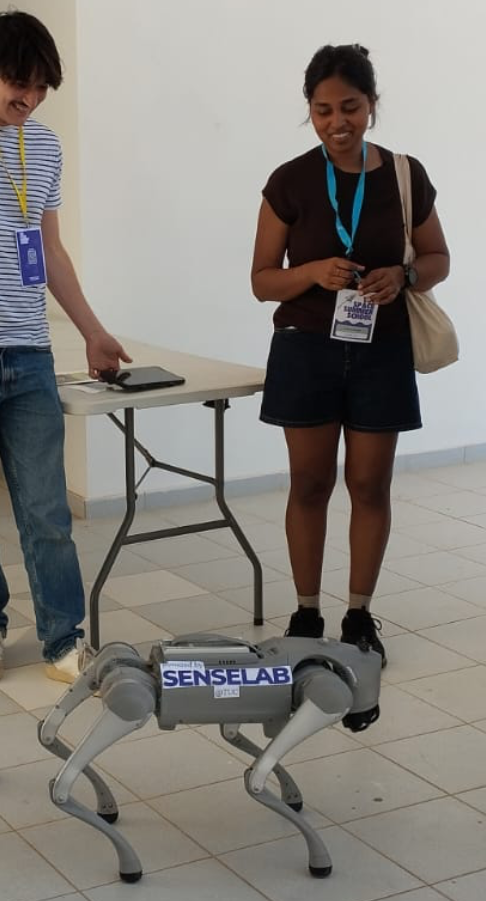
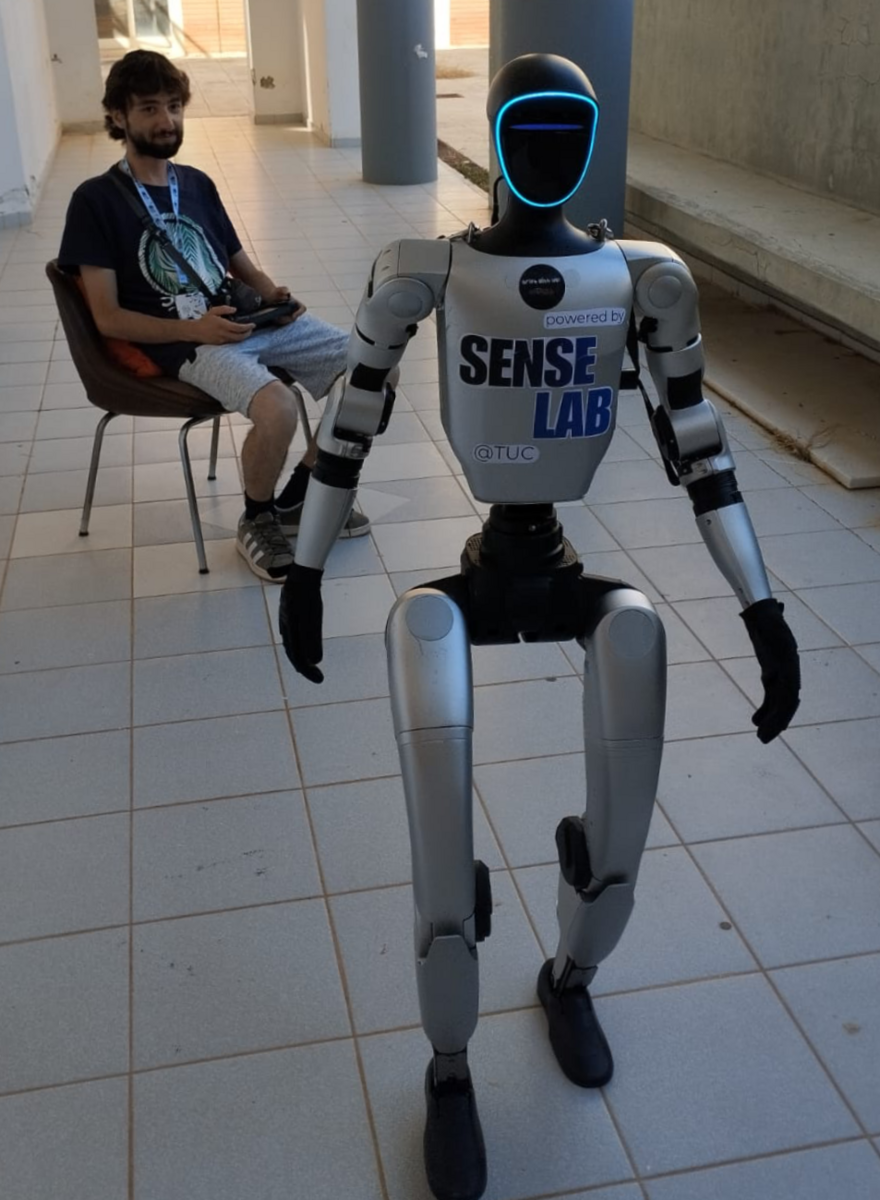
Laboratory of Geodesy and Geoinformatics – SenseLab Space Informatics, Technical University of Crete, Lead: Professor Panagiotis Partsinevelos
“The demonstration features platforms such as the Unitree Go2 quadruped robot, the G1 humanoid robot, and specially designed unmanned vehicles (drones), which perform real-time spatial perception and decision-making under dynamic conditions. By combining these autonomous systems of different forms, intelligent and seamless navigation is achieved in complex and challenging real-world environments.”
The conference organizers would like to thank all sponsors, and particularly the Platinum Sponsors (Starttech Ventures, Epignosis Learning Technologies, Yodeck, and Kaizen Gaming) and the Gold Sponsors (Optasia, ADVANCE Deep Tech Services, and Arian Maritime).
For more information, please visit the conference website: https://www.setn2026.tuc.gr/
SETN 2026 Organizing Committee
Dr. Georgios Chalkiadakis, Professor, Technical University of Crete, Chair of SETN-2026
Dr. Nikolaos Spanoudakis, Assistant Professor, Hellenic Mediterranean University, Co-Chair of SETN-2026
Dr. Michail Lagoudakis, Professor, Technical University of Crete, SETN-2026 Program Co-Chair
Dr. Dimitris Plexousakis, Professor, University of Crete, Vice President of the Hellenic Artificial Intelligence Society, SETN-2026 Program Co-Chair