

 News about the Technical University of Crete RSS feed
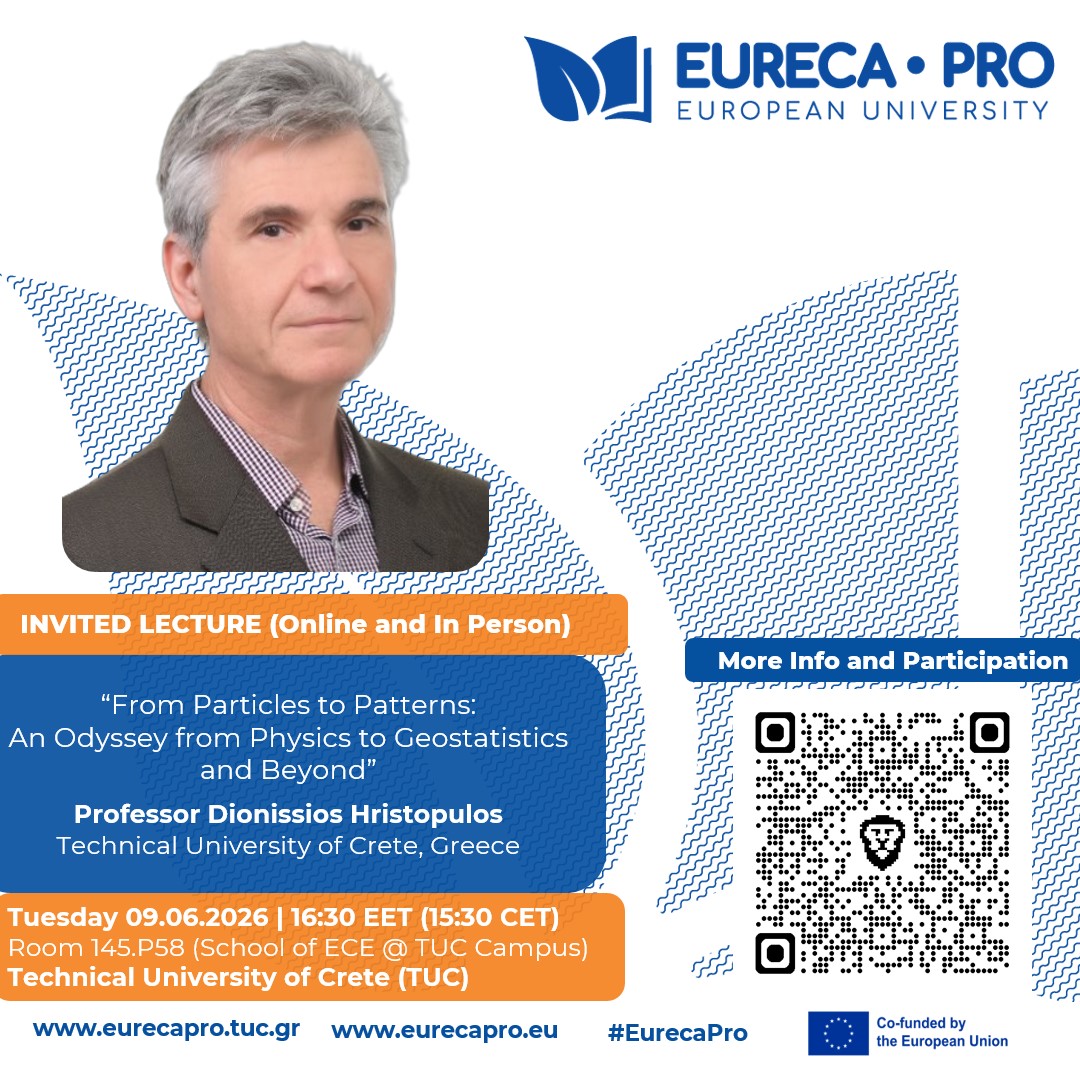


The Technical University of Crete (TUC), proud member of the European University on Responsible Consumption and Production (EURECA-PRO), organizes a series of open scientific lectures to facilitate collaboration among students and faculty from all EURECA-PRO partners.
The next lecture of the series will be delivered by our own Prof. Dionissios T. Hristopulos, Professor with the School of Electrical and Computer Engineering (ECE) at the Technical University of Crete (TUC). Prof. Hristopulos will deliver a celebrated lecture, following the prestigious 2024 Georges Matheron Lectureship Award he received from the International Association for Mathematical Geosciences (IAMG), which recognized his outstanding scientific contributions to spatial statistics and mathematical morphology.
Prof. Hristopulos' lecture is titled:
"From Particles to Patterns:
An Odyssey from Physics to Geostatistics and Beyond"
and is scheduled to take place on:
Tuesday, June 9, 2026 at 16:30 EET (15:30 CET)
and can be attended either physically or virtually:
Room 145.P58 (School of ECE @ TUC Campus)
https://tuc-gr.zoom.us/j/96511690683?pwd=BF3BVAhr7YpNSuHBrRf5FWGdrw3EwF.1
The lecture is open to all interested members of TUC and EURECA-PRO. An official, electronic certificate of attendance will be issued to all actual attendees who will register their participation during the lecture.
Abstract
Understanding and managing our natural resources requires reliable ways to analyze spatial data—from climate variables and soil properties to pollution levels and ecosystem indicators. This talk explores how ideas from physics, geostatistics, and artificial intelligence (AI) can be combined to support sustainable development through efficient and transparent data modeling. We begin by showing that traditional geostatistical methods, such as kriging, are closely related to modern AI tools known as Gaussian process regression. This connection helps bridge established spatial analysis techniques with newer data‑driven approaches used in environmental and sustainability studies. However, applying these methods to the large datasets now common in Earth observation, sensor networks, and climate science can be computationally demanding. To address this challenge, we introduce an alternative perspective inspired by statistical physics. By formulating spatial dependence through local interactions—rather than large covariance matrices—we obtain models that are both physically interpretable and computationally efficient. These stochastic local interaction (SLI) models function as Markov random fields and are particularly well suited for large‑scale spatial prediction and uncertainty assessment, which are essential for sustainable planning and risk analysis. We further discuss how these ideas extend naturally from discrete data to continuous spatial processes, enabling smooth representations of environmental variables. We also briefly explore how concepts from complex systems and statistical physics, such as the Ising model, can help describe collective spatial behavior, for example in land‑use patterns or ecosystem transitions. We conclude by highlighting how physics‑inspired, computationally efficient spatial models can contribute to more informed, scalable, and sustainable decision‑making in environmental and resource management.
Short Bio
Dionissios Hristopulos is a Professor in the School of Electrical and Computer Engineering at the Technical University of Crete (TUC) in Greece. He holds a Diploma in Electrical Engineering from the National Technical University of Athens (1985) and a PhD in Physics from Princeton University (1991), where he did his PhD research in the group of the Nobel Laureate in Physics Philip W. Anderson. Following mandatory military service in Greece, he worked at the University of North Carolina at Chapel Hill for two years as Post-doctoral Researcher and for five years as Research Assistant Professor in the Department of Environmental Sciences and Engineering. In 2000, Dionisis moved to the Pulp and Paper Research Institute of Canada (currently, FPInnovations). For his research he was awarded (jointly with T. Uesaka) the 2003 Johannes A. Van den Akker International Prize for Advances in Paper Physics. Recently, in 2024 he received the Georges Matheron Lectureship Award from the International Association of Mathematical Geosciences. In 2002, Dionissios moved to the Technical University of Crete as Associate Professor in Geostatistics and was promoted to Professor in 2007 in the School of Mineral Resources Engineering (MRE). In 2020, he joined the School of Electrical and Computer Engineering (ECE) at TUC. Dionissios teaches courses in Probability, Statistics, Geostatistics, Time Series, and Random Fields. He has co-authored 202 publications (journal articles, conference proceedings and abstracts, and technical reports) as well as the books “Spatiotemporal Environmental Health Modelling" (Kluwer, 1998) and "Random Fields for Spatial Data Modeling" (Springer, 2020). Dionissios is on the Advisory Board of the journal Stochastic Environmental Research and Risk Assessment (Springer) and the Associate Editor board for Computers and Geosciences (Elsevier). He has served as Director of Graduate Studies in the School of MRE at TUC (2004-2009), as Director of the Master's program in Machine Learning and Data Science (MLDS) in the School of ECE at TUC (2022-2026) and as Member of the University Council of TUC (2012-2017 and 2022-2026). His research explores the intersection of spatiotemporal statistics, time series analysis, statistical physics, and machine learning, along with their practical applications. Dionissios has coordinated and participated in several national and European research projects. He collaborates with engineers, statisticians, mathematicians, physicists, and geologists on the development and application of novel methods for the analysis of spatial and spatiotemporal data. Dionissios also regularly reviews articles that involve interdisciplinary applications of statistical physics, stochastic methods, spatial statistics and signal processing for various international journals. Dionissios has held short visiting professor appointments in the Division of Applied Mathematics, Brown University (2013) and the Space Physics Program in the Department of Astrophysical Sciences, Princeton University (2025).
The event may be broadcast live through the official TUC Facebook page and will be recorded, while photographic material will be taken. The digital material will be displayed on the websites and on the official channels of the Technical University of Crete, EURECA-PRO TUC and the European University EURECA-PRO and will be published on social media, press releases and newsletters. For any issue, which concerns your personal data, you can be informed through the page with TUC's privacy policy.
EURECA-PRO is funded by the European Union under the Grant Agreement No 101124439 "EURECA-PRO 2.0". Views and opinions expressed are however those of the author(s) only and do not necessarily reflect those of the European Union or the European Education and Culture Executive Agency (EACEA). Neither the European Union nor EACEA can be held responsible for them.