
 News about the Technical University of Crete RSS feed
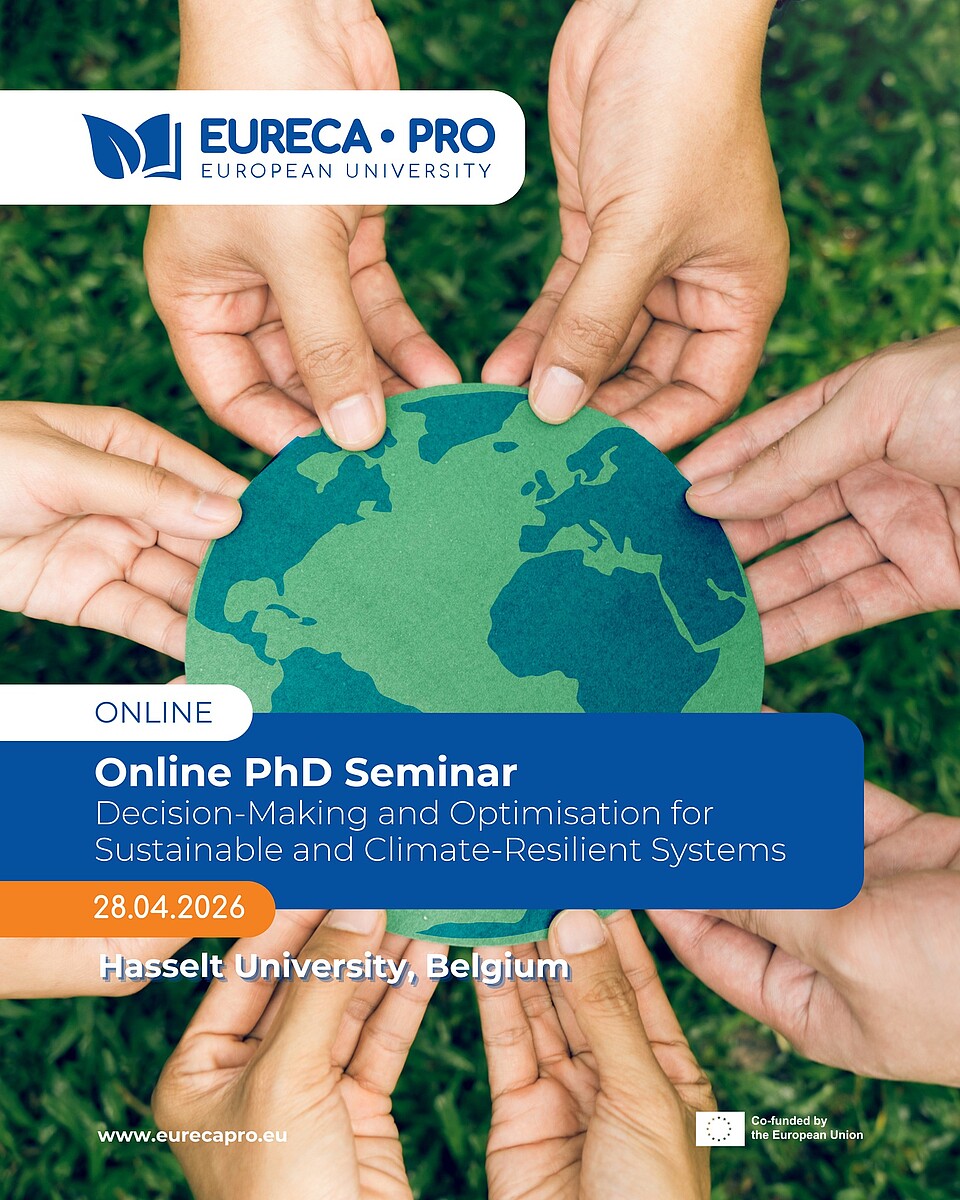


Ready to explore the future of sustainable and climate-resilient systems? Step into the virtual realm of academia with the next online Doctoral Seminar organized by the European University on Responsible Consumption and Production (EURECA-PRO) on the topic of
"Decision-Making and Optimisation for Sustainable and Climate-Resilient Systems"
which will take place on
Tuesday April 28, 2026, 16:00-17:30 CET (17:00-18:30 @ TUC)
In this inspiring PhD seminar, three doctoral candidates will present their latest work addressing key challenges in climate risk, sustainable governance, and advanced optimization methods. This seminar offers a unique look into how different systems – from natural environments to organizations and industrial processes – can respond to growing sustainability and climate challenges and how innovative research approaches contribute to more resilient, responsible, and energy-efficient systems. Meet some of the EURECA-PRO PhD students (with TUC contribution this time!) and learn about their exciting research!
- Julius Emmanuel Emuriat, Silesian University of Technology, Poland
Impact of Selected Climate Features on Disaster Landslides with Climate Change Factors in East Africa
- Alain Patience Ihimbazwe Ndanguza, Silesian University of Technology, Poland
Managerial Competence and Corporate Social Responsibility
- Maria Tsiftsoglou, Technical University of Crete, Greece
A Multi-Objective Firefly Algorithm for Solving the Energy-Efficient Permutation Flow Shop Problem
Find out more and register for free to attend on this page:
www.eurecapro.eu/decision-making-for-sustainable-climate
The event may be photographed, video-recorded or broadcast live through the official channels of EURECA-PRO and its partners. This digital material may be used by EURECA-PRO and its partners for reporting, archival, and dissemination purposes across EURECA-PRO's and partners' official websites and social media channels.
EURECA-PRO is funded by the European Union under the Grant Agreement No 101124439 "EURECA-PRO 2.0". Views and opinions expressed are however those of the author(s) only and do not necessarily reflect those of the European Union or the European Education and Culture Executive Agency (EACEA). Neither the European Union nor EACEA can be held responsible for them.