

 News about the Technical University of Crete RSS feed
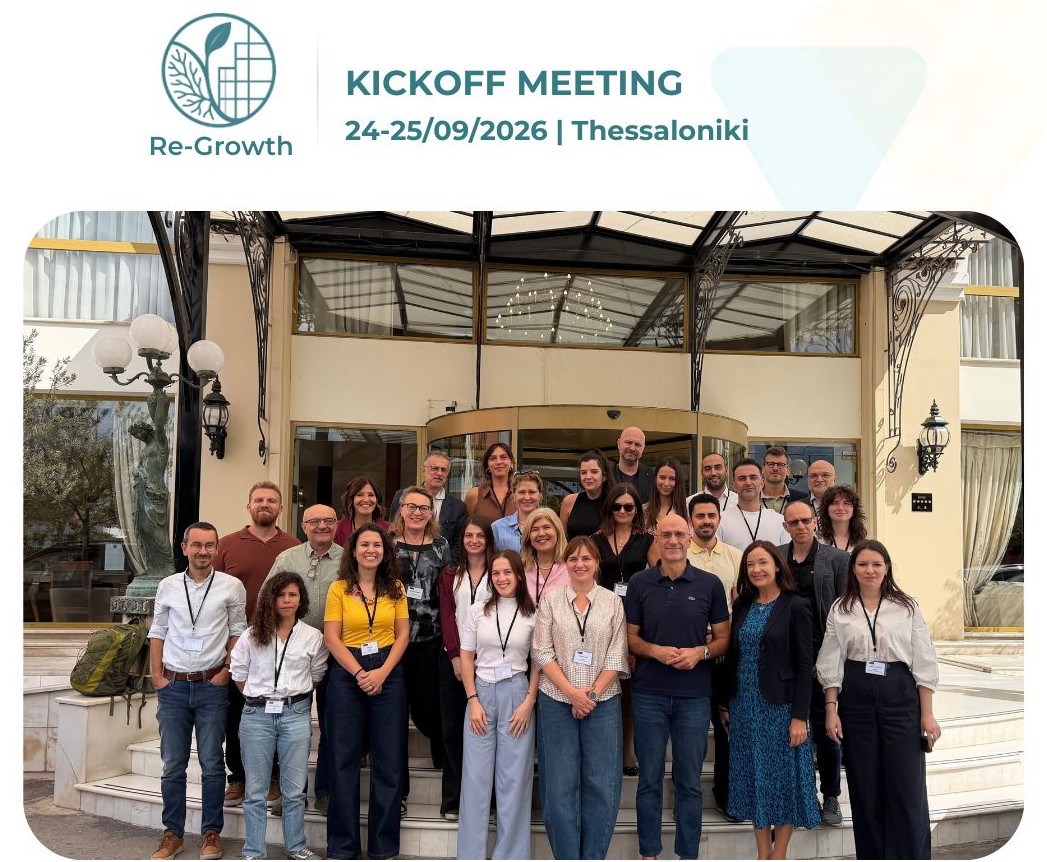
The Technical University of Crete, led by Professor Dionysia Kolokotsa and the Sustainable Built Environment Laboratory of the School of Chemical and Environmental Engineering, is participating in the European research project RE-GROWTH, which aims to develop and assess innovative construction materials produced through biological processes, using residual biomass and bio-based raw materials.
The Technical University of Crete team also includes Professor Dimitrios Gournis (Laboratory of Physical Chemistry and Chemical Processes, School of Chemical and Environmental Engineering), Professor Ioannis Gentekakis (Laboratory of Physical Chemistry and Chemical Processes, School of Chemical and Environmental Engineering), Associate Professor Apostolos Giannis (Laboratory of Toxic and Hazardous Waste Management, School of Chemical and Environmental Engineering), and Associate Professor Maria Mandalaki (Laboratory of Bioclimatic Design and Natural Building, School of Architecture). The University of Ioannina is represented by Professor Charalambos Stamatis (Biotechnology Laboratory, Department of Biological Applications and Technologies).
The project is coordinated by DRAXIS Research Ventures (DREVEN) and is being implemented by a consortium of ten partners from seven European countries. It brings together materials science, biotechnology, and architectural design with active societal participation, aiming to reduce the environmental footprint of the construction sector and strengthen the circular economy. Within this framework, the Technical University of Crete plays a key role in the development, characterization, and assessment of the novel biogenic construction materials.
The University’s research contribution focuses particularly on the laboratory development of mycelium-based panels incorporating residual plant biomass, targeting applications in thermal and acoustic performance. Suitable material compositions and growth conditions will be investigated with the aim of improving the properties and functionality of the resulting materials.
In addition, the Technical University of Crete will lead the assessment of the thermal, optical, and acoustic properties of the biogenic materials developed within the project, contributing to the overall evaluation of their performance for applications in the construction sector.
At the same time, the Technical University of Crete leads the activities related to citizen engagement and interdisciplinary participatory design, coordinating efforts to connect the development of the new materials with the needs, perceptions, and expectations of society. These activities include identifying societal needs, engaging diverse stakeholder groups, and co-creating and evaluating the new materials, with the aim of enhancing their accessibility, social acceptance, and wider adoption.
In Chania, the Technical University of Crete will coordinate demonstration and participatory evaluation activities for the new materials, in collaboration with the Municipality of Chania, the Technical Chamber of Greece – Western Crete Section, and piliko AMKE. Citizens and professionals will have the opportunity to become familiar with and interact with the new materials and contribute their observations to their evaluation and further development, connecting research and innovation with the needs of the local community.
RE-GROWTH is funded by Horizon Europe, the European Union’s framework programme for research and innovation, under the New European Bauhaus Facility funding mechanism. The project has a duration of 36 months and is developing an integrated framework that brings together biomanufacturing, participatory design, technical assessment, sustainability, and the potential for future large-scale production of the new materials.