

 News about the Technical University of Crete RSS feed

The Technical University of Crete strengthens its position on the European research landscape by coordinating the ACT2Flex project. This initiative is funded under the Horizon Europe Framework Programme and is fully aligned with the priorities of the EU Clean Industrial Deal.
Through the indigo research team, led by Associate Professor George Arampatzis, the Technical University of Crete is coordinating a consortium of 16 partners from 6 countries, strengthening its outward-looking approach and international activity. The project aims to redesign and adapt industrial processes, with the goal of creating more flexible and resilient process industries.
Energy-intensive industries lie at the core of the European economy, ensuring the production of valuable products. However, their environmental footprint remains high, as they account for more than 25% of final energy consumption and are responsible for a significant share of greenhouse gas emissions. The increasing penetration of Renewable Energy Sources creates unique opportunities for decarbonisation, but also introduces strong variability in energy supply, to which existing industrial plants are currently unable to adequately respond. In parallel, significant price variations and volatility in energy markets further increase operational uncertainty, affecting production planning, cost efficiency, and overall industrial resilience.
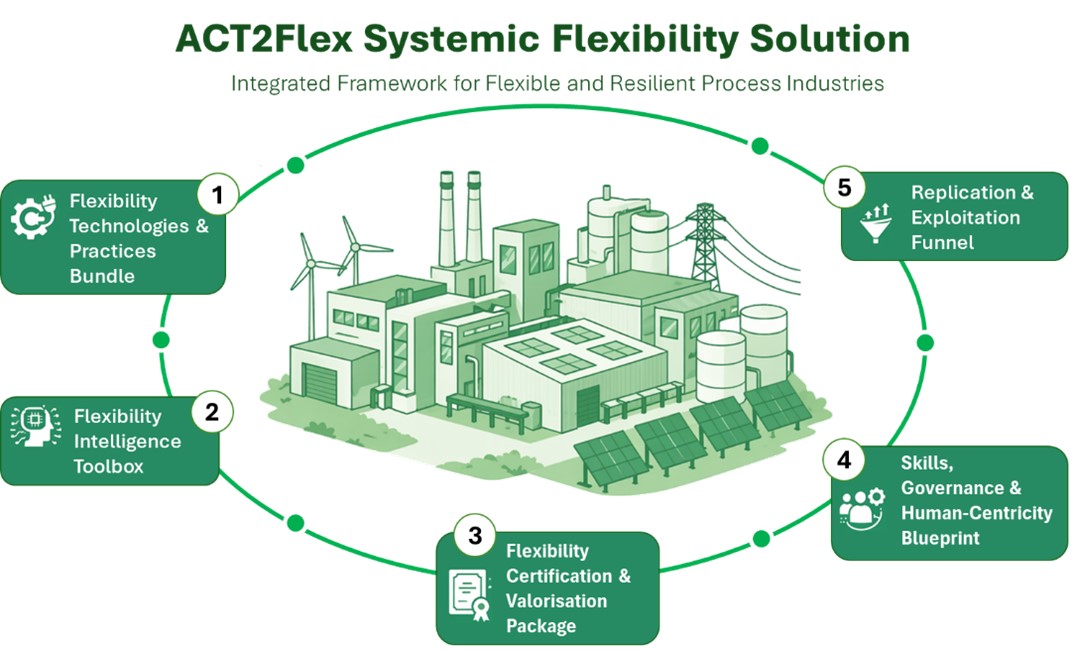
Through its novel Systemic Flexibility Solution, ACT2Flex combines targeted process redesign, hybrid energy integration, storage, and advanced digital tools such as AI-enabled Cognitive Industrial Digital Twins, enabling process industries to dynamically adapt their operations in real time according to the availability of renewable energy and fluctuations in energy prices. The project also introduces certification instruments like Digital Flexibility Passports and Flexibility Balanced Scorecards, while embedding skills, governance, and human-centric practices aligned with Industry 5.0. This enhances flexibility and adaptability and increases resilience to instabilities in energy markets.
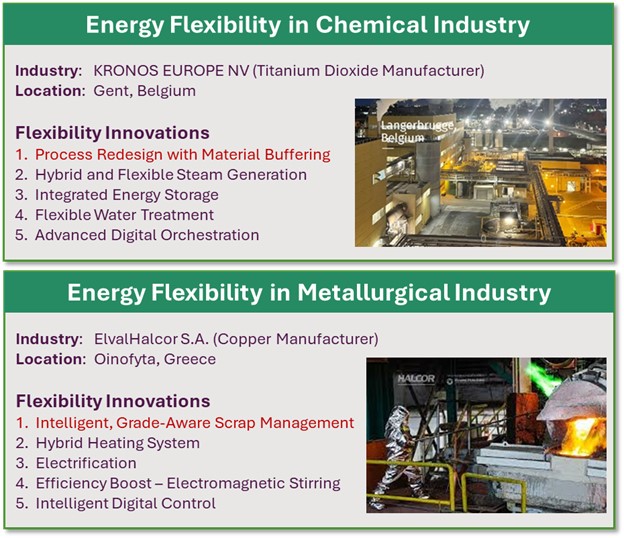
Validation of ACT2Flex solutions is carried out through two large-scale flagship pilot applications under real industrial conditions. The first pilot is implemented in the titanium dioxide chemical production industry of KRONOS EUROPE in Belgium. It focuses on converting energy-intensive continuous processes into batch operation, supported by the use of electric boilers, cogeneration turbine units and innovative energy storage systems. The second pilot (metallurgy) is implemented in Greece, at the facilities of ELVALHALCOR, where a hybrid heating system is applied, combining microwave assisted plasma burners, induction heating, and electromagnetic stirring, enabling dynamic management depending on raw material quality.
In addition to the Technical University of Crete and the two industrial partners, the consortium includes 5 universities (Imperial College London, University of Gent, Brunel University London, National Technical University of Athens and Athens University of Economics and Business), 3 large and small/medium enterprises (Maggioli Spa, IDC Italia Srl, CORE Innovation Center), 3 energy research centers ENGIE Laborelec, EDP CNET–Centre for New Energy Technologies, CEINNMAT Engineering Technologies), and 2 networks (Energy and Turbomachinery Network, The Hellenic Impact Investing Network).
The project, with a total duration of 48 months and total budget 10Μ€, aspires to become a “blueprint” for the future of the European process industry. Through the advanced tools and cutting-edge systems it develops, it transforms energy adaptability into a measurable and tradable asset, strengthening the energy autonomy and competitiveness of European industry.